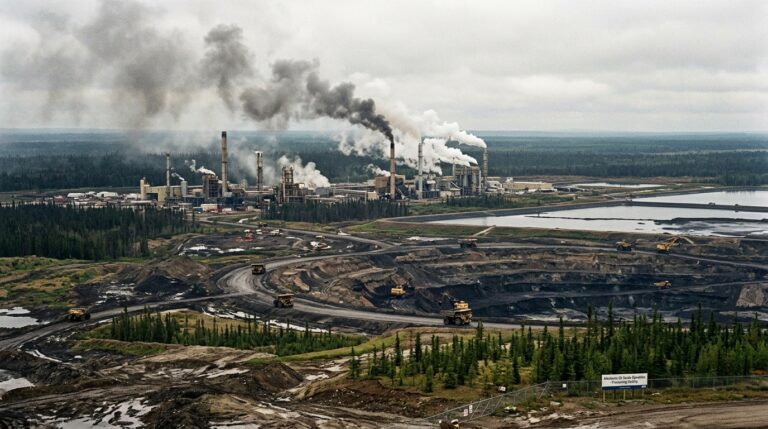
The Alberta-Canada carbon pricing deal is facing growing scrutiny after a new analysis suggested the agreement between Prime Minister Mark Carney and Alberta Premier Danielle Smith may do little to reduce emissions while potentially making it harder for Canada to meet its long-term climate goals.
The debate over carbon pricing, Alberta carbon pricing, carbon emissions, and Canada’s climate targets has intensified following a report from the Canadian Climate Institute, which examined the potential impact of the federal-provincial agreement. According to the analysis, the Alberta-Canada carbon pricing deal may produce only modest emissions reductions and could even result in higher carbon pollution under certain scenarios.
The findings have reignited discussions about carbon pricing, pipeline expansion, Alberta emissions, oil production, greenhouse gas pollution, and Canada’s path toward achieving its environmental commitments.
What Is the Alberta-Canada Carbon Pricing Deal?
The Alberta-Canada carbon pricing agreement emerged from negotiations between the federal government and Alberta over energy development and climate policy.
In May, Prime Minister Mark Carney and Alberta Premier Danielle Smith signed an implementation agreement that supports the development of a potential new pipeline to Canada’s West Coast while introducing changes to industrial carbon pricing.
The agreement includes a carbon pricing framework that would eventually establish an effective carbon price of $130 per tonne by 2040 across Canada.
However, the deal also modifies previous plans that would have increased the carbon price to $170 per tonne by 2030.
Supporters argue the Alberta-Canada carbon pricing deal balances economic growth with environmental responsibility. Critics argue the lower carbon pricing trajectory weakens incentives for emissions reductions and could increase the country’s dependence on fossil fuel production.
Canadian Climate Institute Raises Concerns
The Canadian Climate Institute’s analysis has become a central part of the debate.
According to the report, emissions reductions resulting from the Alberta-Canada carbon pricing agreement are “not really significant.”
Dave Sawyer, principal economist at the Canadian Climate Institute, stated that the expected reductions are relatively small when compared to Canada’s overall emissions profile.
The analysis suggests that under the most optimistic scenario, Canada’s emissions would remain largely unchanged. Under less favorable conditions, emissions could increase.
That conclusion has fueled criticism from environmental advocates who argue stronger carbon pricing is necessary if Canada hopes to achieve its climate targets.
The report also questions whether emissions reductions generated by the carbon pricing changes would be sufficient to offset emissions associated with expanded oil production and potential pipeline development.
Why Carbon Pricing Remains Controversial
Carbon pricing has been one of the most debated climate policies in Canada for years.
Supporters of carbon pricing argue that putting a financial cost on emissions encourages industries to invest in cleaner technologies, improve efficiency, and reduce greenhouse gas pollution.
Critics of carbon pricing often argue that higher carbon costs can reduce competitiveness, increase operating expenses, and create economic challenges for energy-producing regions.
The Alberta-Canada carbon pricing deal attempts to strike a middle ground between those competing priorities.
However, the new analysis suggests that achieving both economic growth and significant emissions reductions may prove difficult.
The effectiveness of carbon pricing depends heavily on whether industries respond to market signals by lowering emissions. If those incentives weaken, environmental benefits could be reduced.
Alberta’s TIER System Faces New Questions
Much of the discussion surrounding the Alberta-Canada carbon pricing deal focuses on Alberta’s industrial carbon pricing framework known as the Technology Innovation and Emissions Reduction Regulation, commonly referred to as TIER.
The TIER system allows major industrial facilities to earn carbon credits when they reduce emissions below established benchmarks.
Companies that exceed emissions targets can purchase these credits to meet compliance requirements.
The concept is designed to encourage emissions reductions through market-based incentives.
However, the Canadian Climate Institute argues that recent changes have created an oversupply of carbon credits.
As supply increased, credit prices fell significantly below Alberta’s official carbon price benchmark.
At one point, some credits reportedly traded for around $20 per tonne despite a benchmark price much higher than that level.
The Alberta-Canada carbon pricing agreement includes measures intended to establish a stronger price floor for those credits.
Yet analysts remain uncertain whether that mechanism can effectively stabilize the market.
Carbon Credit Prices Continue to Fall
One of the most closely watched developments involves recent movements in Alberta’s carbon credit market.
According to market data cited in discussions surrounding the report, TIER carbon credit prices have declined sharply.
Prices reportedly fell from approximately $42.25 per tonne to around $31.50 per tonne shortly after the Alberta-Canada carbon pricing deal was announced.
For critics, those declines raise concerns about whether the carbon pricing system is sending a strong enough signal to encourage emissions reductions.
If carbon credits remain inexpensive, companies may have less financial motivation to invest in emissions-cutting technologies.
That concern is central to the Canadian Climate Institute’s skepticism regarding the agreement’s environmental effectiveness.
Federal Government Defends the Carbon Pricing Agreement
The federal government has pushed back against criticism of the Alberta-Canada carbon pricing deal.
Federal officials argue the agreement creates a practical and workable industrial carbon pricing framework while supporting economic growth.
Government representatives have also pointed to broader climate initiatives that were not fully incorporated into the institute’s analysis.
Among those initiatives is the federal commitment to expand and modernize Canada’s electricity grid.
Supporters argue that cleaner electricity infrastructure could help reduce emissions from multiple sectors over time and complement the carbon pricing framework.
Federal officials maintain that the Alberta-Canada carbon pricing agreement should be viewed as one component of a larger climate and energy strategy.
Alberta Rejects Criticism
Alberta officials have been even more direct in rejecting the report’s conclusions.
Provincial representatives argue Alberta has already demonstrated that emissions reductions and energy production growth can occur simultaneously.
They contend that critics place too much emphasis on reducing oil production rather than encouraging technological innovation.
The province also maintains that Alberta’s industries are making measurable progress in reducing emissions intensity while continuing to support jobs, investment, and economic growth.
According to Alberta officials, the Alberta-Canada carbon pricing deal reflects a more realistic approach that recognizes the importance of Canada’s energy sector.
Pipeline Expansion Remains a Key Issue
Beyond carbon pricing, the agreement has generated significant attention because of its connection to a proposed West Coast pipeline.
The project could eventually increase Canada’s oil export capacity and support additional production from Alberta’s energy sector.
Critics argue that increased production may make it more difficult for Canada to reduce greenhouse gas emissions.
Supporters counter that global energy demand remains strong and that Canadian energy can be produced under stricter environmental standards than many international competitors.
The relationship between pipeline expansion, carbon pricing, and emissions reductions will likely remain one of the most controversial aspects of the Alberta-Canada carbon pricing deal.
Canada’s Climate Targets Face New Uncertainty
Canada has established ambitious climate targets aimed at reducing greenhouse gas pollution over the coming decades.
Achieving those goals requires substantial reductions across multiple sectors, including transportation, electricity, manufacturing, and oil and gas production.
The Canadian Climate Institute’s analysis suggests the Alberta-Canada carbon pricing deal may not deliver emissions reductions at the scale required to meet those objectives.
Whether the agreement ultimately succeeds may depend on several factors:
- The effectiveness of Alberta’s carbon credit price floor.
- Future investment in emissions-reduction technologies.
- Electricity grid expansion.
- Industrial compliance with carbon pricing rules.
- Growth in oil and gas production.
- Broader federal climate policies.
The Future of Carbon Pricing in Canada
The debate surrounding the Alberta-Canada carbon pricing deal is unlikely to disappear anytime soon.
For supporters, the agreement represents a pragmatic compromise that protects jobs, supports energy development, and maintains a carbon pricing framework.
For critics, the deal risks weakening one of Canada’s most important climate tools while potentially increasing emissions through expanded oil production.
As governments, industry leaders, environmental groups, and economists continue evaluating the agreement, carbon pricing will remain at the center of Canada’s climate policy discussions.
The ultimate success or failure of the Alberta-Canada carbon pricing deal may not be fully understood for years, but the questions raised by the Canadian Climate Institute ensure that carbon pricing, emissions reductions, Alberta energy policy, climate targets, and Canada’s environmental future will remain major topics of national debate.